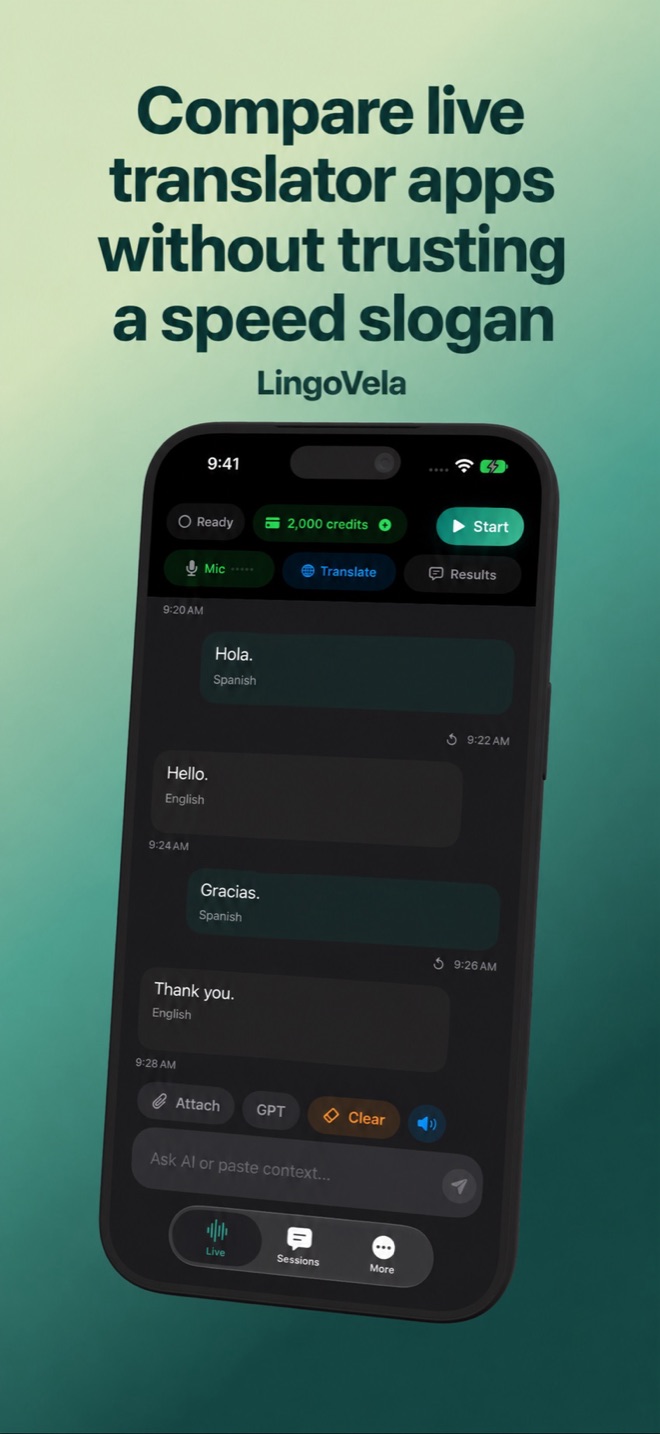
Compare live translator apps without trusting a speed slogan
An early subtitle and a finished spoken translation measure different experiences. Compare the output you need, using the same language pair, audio setup and source material. We publish this method as LingoVela’s developer and have a commercial interest in the app.
Read the method behind a claim
Check whether timing starts at the first spoken word or after a sentence ends. Ask whether the result is draft text, committed text or spoken output. These measure different experiences and should not be put in one table as if they were identical.
Test what an early prediction does when the sentence changes
Kotoba’s interpreter-app page describes predictive translation specifically in subtitle mode, with timing dependent on conditions. Treat that as the publisher’s description of an output surface, not proof of the same experience from translated speech or another application.
For an original trial, use a sentence with a correction: “Please send six — sorry, sixteen — blue samples.” Watch what appears before the correction, what changes after it and what the listener actually hears. A quick draft that is corrected later may be useful for following a talk, but it should not be mistaken for a confirmed quantity.
- Observe the earliest visible translation without treating it as the final result.
- After the correction, check whether the displayed quantity changes and whether that change is clear to the reader.
- Listen to the complete spoken output separately. If an earlier quantity has already been voiced, check how the correction reaches the listener.
- Repeat with a negation and a speaker change. Ask a proficient speaker to check meaning, not just fluency.
Keep separate timestamps for text and speech
Use one recording or observation timeline for the source and the output, with participant permission where recording is needed. Name the reference point for every interval: first source speech or the end of the source sentence. Do not mix these baselines in a ranking.
Note when draft text first appears, when the text you would act on is complete, when translated audio first becomes audible and when the whole spoken meaning has arrived. If a product does not expose one of those surfaces, mark it unavailable rather than assigning it a zero delay. These are proposed observation fields, not measured LingoVela results.
Separate measured trials from projections
A formula that estimates a longer conversation is not another observed trial. Check which durations, language pairs, devices and output surfaces were actually tested, and which values were calculated from assumptions. Exbabel’s lab page, for example, separately labels duration-based latency projections; that publication is not an independent verification by us of either product’s performance.
When keeping your own comparison notes, label each item as a publisher claim, an observed test or a projection. A declared testing standard or a downloadable report does not replace checking the method and the relevant original results. A timing result also does not establish that names, quantities or meaning were translated correctly.
Check that both products received the same material
Exbabel’s linked report and summary JSON compare one short utterance on its own product with three different utterances on Wordly. The report acknowledges the unmatched material, small sample, network uncertainty and untested configuration options. Reading its numbers is not the same as repeating the experiment, and the linked source recordings are not supplied as public media in that report.
For your own test, give each candidate the same recording or carefully controlled live exchange, then repeat it. Keep a short greeting, a correction and a longer passage as separate cases. Compare the same language direction and output surface within each case rather than averaging unlike tasks into a product-wide score.
A first translated word can arrive before the whole sentence. Record when the complete meaning becomes available as well as when output starts. Keep a missing result, a changed quantity and a playback problem in separate columns. Published arithmetic can be internally consistent while the experiment remains too limited to establish a general ranking.
Keep published claims attributed
LiveLingo and OmniTalk publish product and comparison material. Treat vendor claims as vendor claims until you have reviewed the method and repeated the relevant test. This page does not invent a LingoVela speed, error rate or independent test result.
Compare a small representative exchange
Use the same source material and devices. Include background noise only if it represents your situation. Record missing phrases, changes of speaker, errors in meaning and whether corrections appear after speech. A fast wrong answer is not a successful translation.
Keep missing output separate from slow or incorrect output
Use a small observation sheet for each exchange: source reference, language direction, output surface, whether the result arrived, whether the meaning survived and whether it changed later. A bilingual reviewer can mark the important detail correct, wrong or unclear. Do not turn an unclear result into an assumed success just because it reads naturally.
If a translation never arrives, record that separately from a late translation. If playback is captured again by the microphone, record the audio-route problem before comparing model speed. A reconnect, a headset change or a new speaker can change the setup; repeat the affected exchange before combining the results with earlier observations.
Explain the product boundary
LingoVela is focused on translation on iPhone and iPad. Its provider choice does not establish telephone bridging, browser captions or a meeting plugin. If those are the features you need, compare products explicitly designed for them.
Does predictive translation mean the final translation is already correct?
No. An early result can be provisional. Test a correction or negation, inspect the final text and listen to the complete spoken output. Kotoba’s publisher specifically describes its prediction in subtitle mode; do not transfer that claim to every output or app.
Which translation latency should I compare?
Name both the source reference point and the output: for example, the end of a source sentence to completed translated speech. First visible text, stable text and first audible speech are different observations. Compare the same one across products.
Can I rank apps from a single short sentence?
A short sentence is only one observation. Include a correction, intentional repetition, speaker changes and the conditions you expect to use. Check meaning with a proficient speaker and keep missing output distinct from a slow result.
Has LingoVela been independently shown to beat these apps?
No independent speed or accuracy result is established in this guide. It provides a proposed comparison method and links to publisher material; it does not turn vendor claims into a verified ranking.
Does a downloadable dataset make a comparison independently verified?
No. Check whether it supplies original recordings, matched repeated trials and enough settings to reproduce the result. A summary JSON file and arithmetic consistency do not by themselves verify the capture, output meaning or a product-wide speed claim.