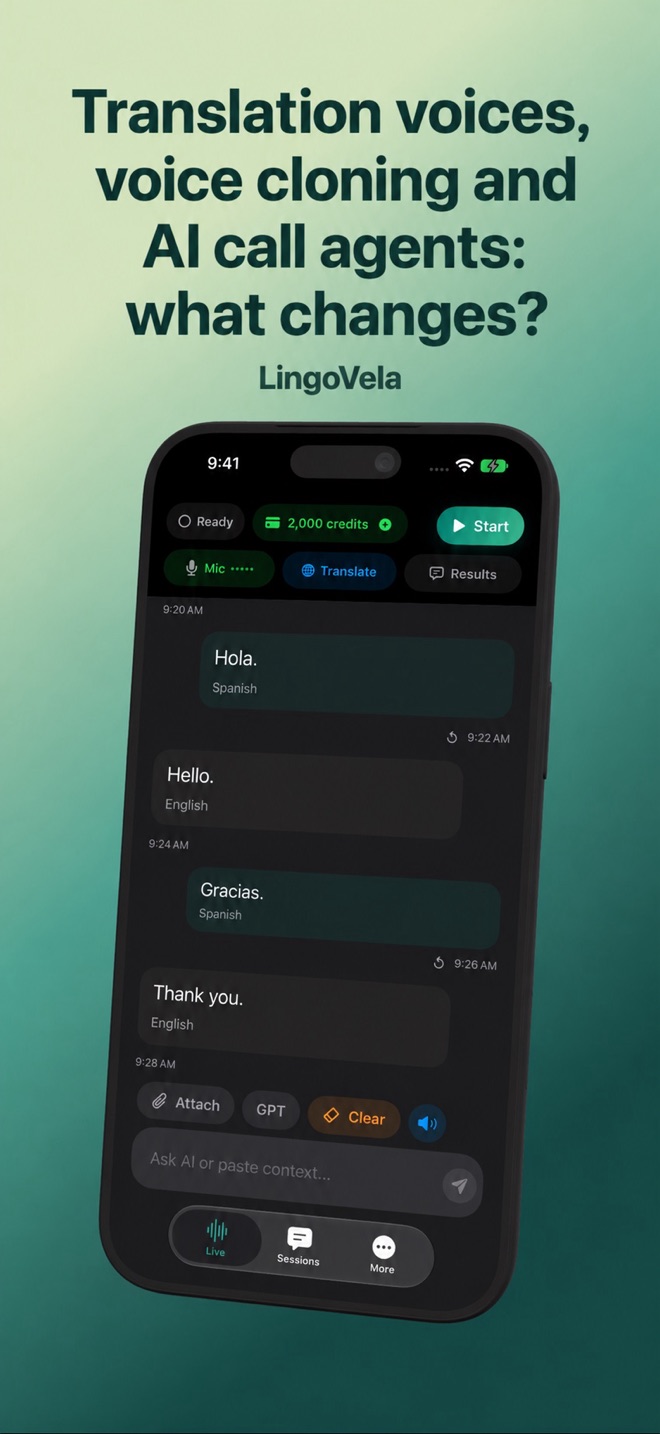
Translation voices, voice cloning and AI call agents: what changes?
An app can speak a translation without copying your voice or making decisions for you. Before using an AI voice tool, establish what the other person will hear and who controls the message.
Three separate choices
A translation voice reads words in the target language. Voice cloning attempts to reproduce characteristics of a particular speaker. An autonomous call agent may decide what to ask or answer while pursuing a task. None of these descriptions by itself proves translation accuracy.
A tool marketed for phone calls also needs a way to join or place the call. LingoVela does not provide a telephone bridge or an autonomous calling agent. Its conversation workflow should not be mistaken for either service.
An agent can have a human takeover control
Google’s current Call for me help describes reviewing the task, destination number and details to share before starting. The user can monitor a transcript or call audio and take over; Google says takeover unmutes the user’s microphone and the assistant announces the handover before leaving. An agent conducting the exchange is therefore different from a product with no possible human intervention.
Google documents eligibility, supported destinations, a daily call limit and carrier charges. Check its current requirements rather than assuming that the feature is available on every phone or is included with any translation subscription. This is an attributed example of a calling workflow, not a LingoVela function or an independent call test.
Define what a delegated task is allowed to decide
For an original planning example, imagine asking a tool to enquire about a bicycle repair. Asking whether the workshop can inspect the bicycle is different from agreeing to a repair price or accepting replacement parts. Write down the question, the information you permit the tool to share and the point where you need to decide yourself.
An interpreter-style workflow should convey your intended message. An agent may be asked to choose its next question or complete a task. Before using either, establish how to correct an unintended statement and what happens if the other person asks something outside the agreed scope. Do not infer those controls from a natural-sounding voice.
- What question may the tool ask, and what outcome are you seeking?
- Which details may it disclose, and to which verified recipient?
- Which alternatives may it accept without asking you again?
- How will you stop, correct or take over the exchange if needed?
Make the translation understandable to both people
At the start of an exchange, explain that you are using automatic translation. A short introduction helps the listener understand the pauses and gives both people permission to request a correction.
Agree on how to handle uncertainty: repeat a sentence, write a name, or show the original and translated words. If the output says something you did not intend, stop and correct it rather than continuing simply because the voice sounds fluent.
Test the voice without confusing it with the model
Voice selection, language recognition and translation meaning are separate layers. When an app allows a playback-voice choice, test the new voice with the same short sentence. Changing voice should not be treated as evidence of improved meaning.
Do not assume a voice label means the app has copied a person’s identity or accent. Check the product’s explanation of voice generation and data use before providing any material for a cloning workflow.
A practical check before an important conversation
Use a harmless test rather than private customer or family audio.
- Verify whether the tool translates your words or generates its own replies.
- Check whether it uses a stock voice, a selected voice or a custom voice workflow.
- Ask a bilingual speaker to verify a short question and reply when possible.
- Check the transcript for names, numbers and negation.
- Switch to an appropriate human service when the situation needs qualified interpreting.
Confirm the outcome separately from fluent speech
A convincing voice or tidy summary is not confirmation that the recipient accepted what you intended. After a delegated task, distinguish what the tool asked, what the recipient actually agreed to and what remains unresolved. Use the available record and an appropriate confirmation channel rather than assuming that a summary completes the transaction.
For a voluntary practice session, use a partner and fictional details. Have the partner offer an alternative time and ask an unexpected follow-up. Check whether the chosen workflow preserves the correction, pauses for your decision or follows its documented takeover process. This is a suggested exercise; we have not performed a success-rate comparison of call agents.
- Set an explicit fictional request and one boundary the tool must not decide for you.
- Check the recipient and the information to be shared before starting the supported workflow.
- Have the partner offer an alternative, then verify who approves it.
- Use the documented stop or handover control and confirm who is now speaking.
- Review the outcome for the corrected detail and mark unanswered questions as unresolved.
Check the call record and the data path
A voice sample, live audio, a transcript and a post-call summary are different records. Check the selected provider’s explanation of what is processed, saved and accessible to you or others. If you need deletion or export, verify those controls for the actual service and plan. Do not assume that a voice-selection menu creates a clone or that a translated call is never recorded.
This comparison does not establish recording permission, compliance or a legal exemption for any call type. Use the arrangements applicable to your situation and provider. LingoVela’s consent and data controls cover its own supported workflows; they do not authorise another service to place calls or use a person’s voice.
Does an AI calling agent necessarily remove every human control?
No. Check the product. Google’s current Call for me instructions describe task review, monitoring and a takeover control. Those controls are specific to that service, not a guarantee about all agents.
Does choosing a translation voice mean my voice has been cloned?
No. A playback voice and a custom identity-copying workflow are different features. Check how the selected provider describes voice generation.
Does a fluent call summary prove a booking was confirmed?
No. Check what the recipient agreed to, the final details and any unanswered conditions through an appropriate confirmation process.
Can LingoVela place calls or negotiate for me?
No. It is not a telephone bridge or an autonomous calling agent. Use its documented translation workflows and check a separate provider for call integration.