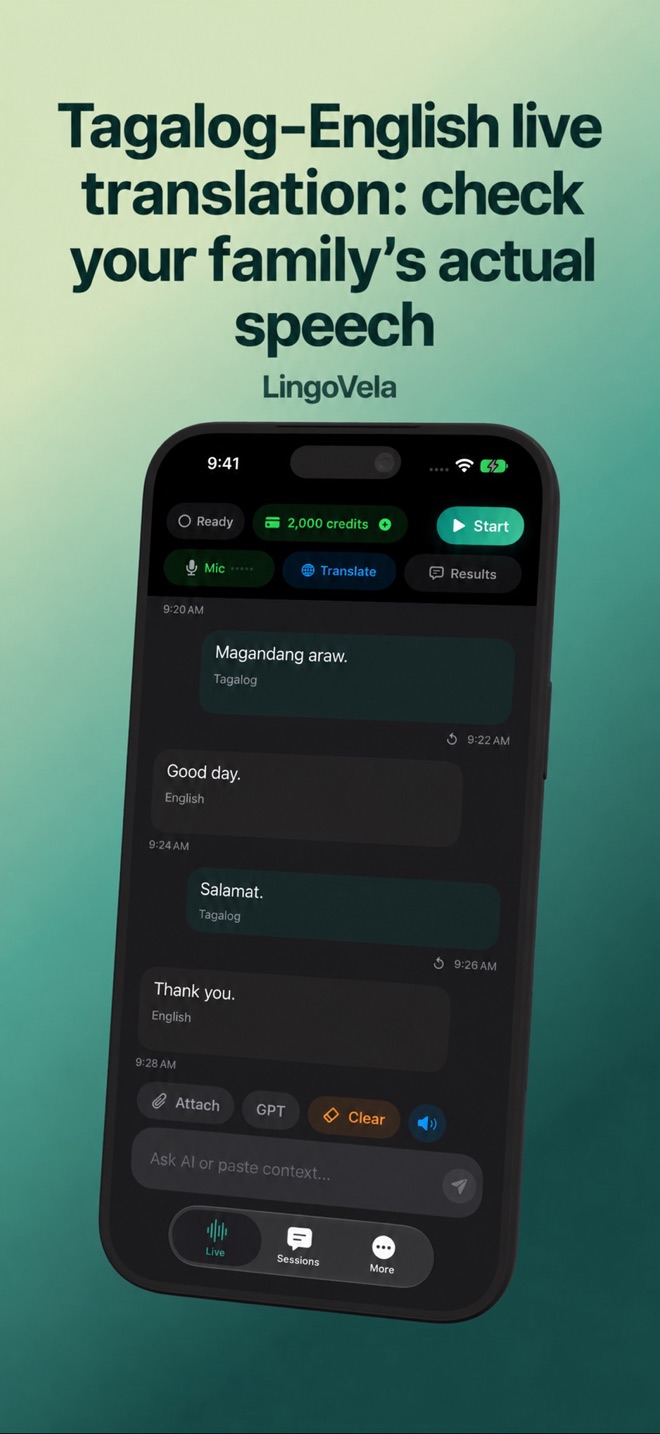
Tagalog–English live translation: check your family’s actual speech
For a family conversation, test the way your relatives actually speak. A clean single-language demonstration may not represent an exchange that switches languages, uses nicknames or refers to shared events.
Agree on the language selection
Ask the speaker which language they need and inspect the application’s available choices. Do not assume that a country label or a translated interface means the app recognises all the languages used there.
OpenAI’s text-to-speech documentation lists Tagalog, but that is documentation for a particular speech-generation workflow. It is not proof of LingoVela’s complete realtime recognition, translation or offline pipeline. Validate the actual mode on the actual phone.
Test mixed speech deliberately
If the conversation mixes Tagalog and English, include that pattern in a short test. Compare it with a sentence spoken wholly in one language. This helps reveal a recognition problem without assuming that every mixed turn will be detected correctly.
Check whether an English name or phrase was kept as intended. If the recogniser has treated a name as an ordinary word, show the spelling and repeat a complete sentence with that name.
Rehearse a family plan
Use fictional arrangements so an error does not affect a real booking.
- Ask whether someone is arriving today or tomorrow.
- Confirm how many people are coming.
- Give a name and a meeting place in writing.
- Say that the plan has not been cancelled.
- Have the Tagalog speaker ask a follow-up question, then test the English response.
Prepare a backup for a missed turn
Keep messages short enough to clarify, but complete enough to include who or what is being discussed. If voice input fails, try typing the intended sentence and compare the result. Do not mistake that fallback for proof that voice support is ready.
In LingoVela, check the language and mode availability before subscribing for this specific use. All translation modes require an active subscription. Local speech needs compatible prepared assets; online modes require internet and credits. This is a preparation guide, not a measured quality claim for Tagalog–English.