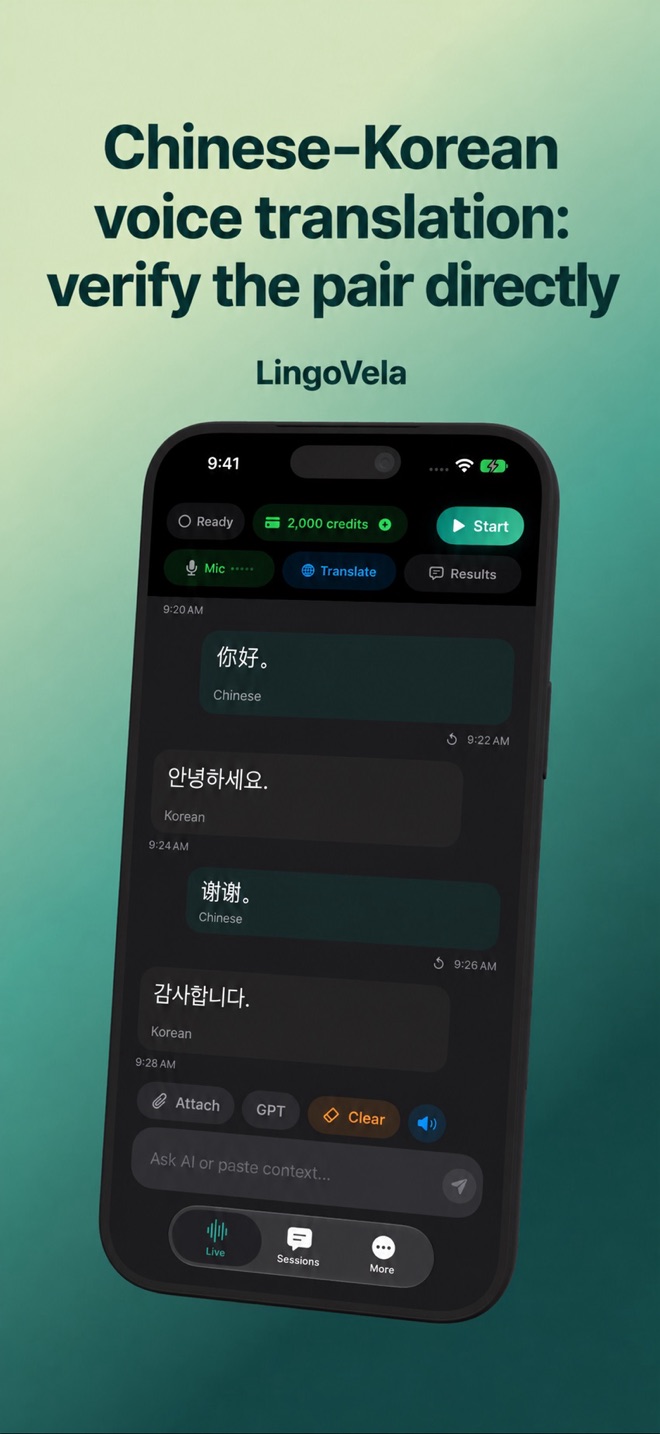
Chinese–Korean voice translation: verify the pair directly
A translator demonstrated in English does not automatically prove its Chinese–Korean workflow. Test the exact two languages and the way both people will speak and read.
Specify both sides before the test
Identify the Chinese spoken language and written form that the first person needs. Identify the Korean input and output that the other person needs. Avoid selecting a vaguely similar language because it appears near the desired one in a list.
Keep written names, addresses and product labels in their original forms. If a translation is going to be used to find a particular place or item, the original label gives both participants something concrete to check.
Test the direct exchange
Use the Chinese and Korean selections together in the actual product. A Chinese-to-English demonstration followed by a Korean-to-English demonstration is not the same test. Do not assume an application uses or avoids an intermediate language unless the provider documents that architecture.
Check the captured source text and result on each turn. If a detail changes, repeat it as part of a complete sentence, then show the written number or name.
Try a shop or supplier scenario
Choose a simple, non-sensitive sample rather than a real purchasing commitment.
- Show a product label and ask whether the item is available.
- Ask for the quantity and the delivery date separately.
- Correct one quantity while keeping the item unchanged.
- Let the other person ask a question in Korean and check the Chinese reply.
- Write the final item, quantity and date for both people to confirm.
Using LingoVela without assuming universal support
Inspect the chosen mode’s pair availability and prepare any required assets. Verify typed input, speech in both directions and spoken playback separately. On Device requires compatible installed recognition, translation and voice components.
An active subscription is required for LingoVela translation. Online modes need internet and credits. This guide supplies a test procedure, not an independently verified Chinese–Korean benchmark or a promise of offline support on every device.