Japanese food vocabulary: eight useful words to recognise
Start with a few words you can recognise, then keep the complete menu description in view. Knowing the name of a food group does not tell you everything about a finished dish.
Start with rice, bread, fish and meat
These forms, readings and basic meanings are checked against the Japan Foundation’s Marugoto Starter wordbook, pages 22–23. We use its beginner-friendly kana forms here. A restaurant may show a different written form or a longer dish name, so compare the full original label rather than only the first word.
- ごはん — gohan — cooked rice.
- パン — pan — bread.
- さかな — sakana — fish.
- にく — niku — meat.
Add four more useful words
Use the reading aids to connect the written word with a reference recording or a teacher’s pronunciation. Roman letters are a starting aid; they are not a pronunciation score.
- たまご — tamago — egg.
- やさい — yasai — vegetables.
- ぎゅうにく — gyuuniku — beef.
- とりにく — toriniku — chicken.
Read the full menu entry
If you recognise a word for vegetables, check what the entire dish description says. That one word does not establish how the dish is prepared or which other ingredients it contains. Likewise, recognising fish or meat does not tell you the portion, cooking method or accompanying items.
Keep the item’s original name and any item number visible when speaking with staff. Ask about one detail at a time. If you need to avoid an ingredient, confirm the specific dish with the people preparing it rather than treating a translated food label as confirmation.
Turn the words into a small practice task
The official wordbook gives a learning reference rather than a promise that you can understand every menu. Use it to practise recognition, then check the new context.
- Pick two of the eight words and find their kana in the learning reference.
- Read the word, cover the reading aid and try recognising it again.
- Look at a real menu and keep the entire item name beside your notes.
- Ask a proficient speaker to check what the full item name means.
- Keep a checked translation with its context if you want to add it to a personal phrase list.
Use LingoVela for the conversation around the menu
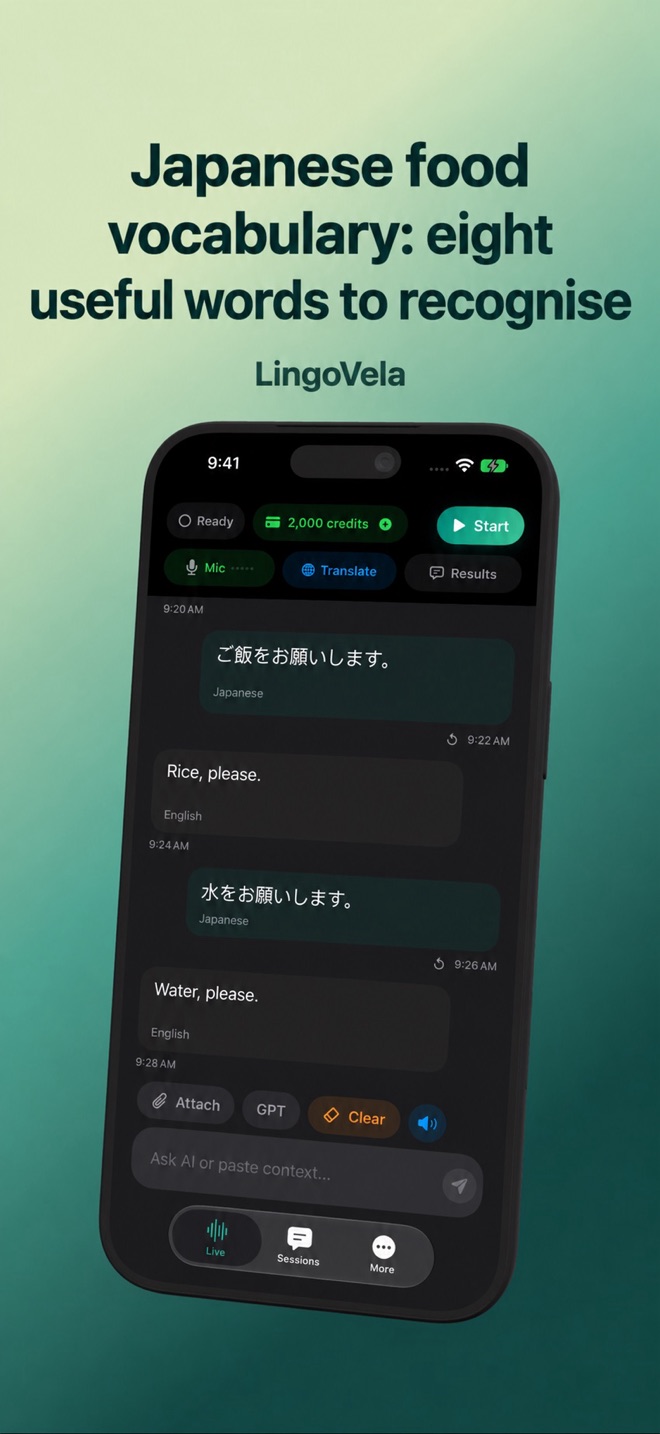
LingoVela can assist with a supported conversation or input workflow; it does not certify a menu, teach a complete Japanese course or guarantee recognition of every image. For a photo, check the visible text and the support of the installed version and chosen mode before relying on its translation.
We publish this guide as LingoVela’s developer. An active subscription is required in every translation mode. On Device uses no AI credits but requires compatible prepared assets. Online modes require internet and credits. Test Japanese and your other language on the device you plan to take.
Are these eight words a complete Japanese menu translator?
No. They are a short recognition exercise. Keep the full item name and description visible and check uncertain details with staff or a proficient speaker.
Why are the examples written in kana?
They follow the beginner forms checked in the Japan Foundation reference. Real menus can use other written forms and longer names, so learning these entries does not guarantee that you can read the whole menu.