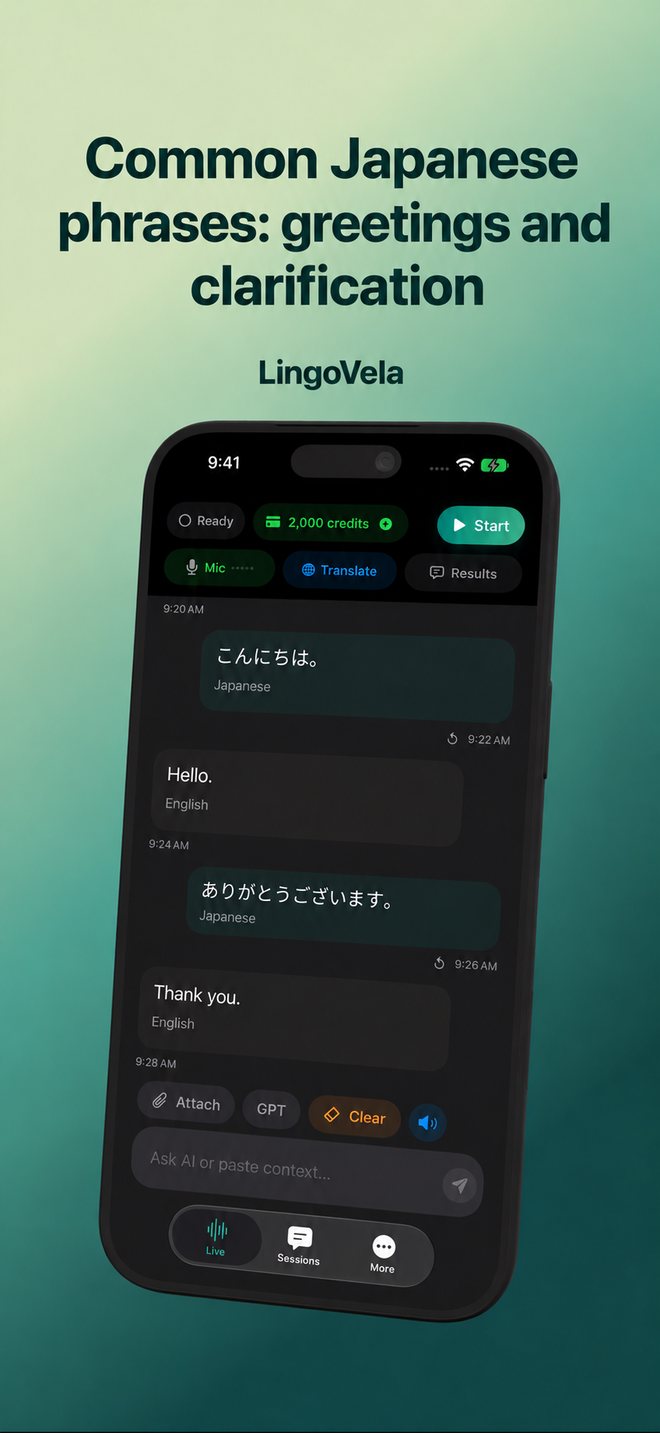
Common Japanese phrases: greetings and clarification
Start with a few greetings, thanks and an apology, then learn how to ask for clarification when the reply is unclear. These nine expressions are a small practical set, with official lesson references and listening practice.
Three greetings for meeting someone
The Japanese forms and basic situations below are checked against the Japan Foundation’s Irodori Starter lesson 1. The reading aids use doubled vowels where a sound is held longer; they are a starting aid, not a substitute for listening to the lesson audio.
- おはようございます — ohayoo gozaimasu — a polite “good morning”. Practise the full expression before shortening it for familiar company.
- こんにちは — konnichiwa — a daytime greeting, often rendered “hello” or “good afternoon”. In this greeting, the final は is pronounced wa.
- こんばんは — konbanwa — “good evening”. Its final は is also pronounced wa.
Three polite expressions for a small exchange
Learn what is happening in the exchange as well as the English gloss. The same short expression can serve a different purpose depending on context.
- ありがとうございます — arigatoo gozaimasu — a polite way to say “thank you”.
- すみません — sumimasen — “sorry” or “excuse me”, depending on the situation. The Irodori examples also use it in appreciative responses when someone has gone to trouble to help.
- どうぞ — doozo — “here you go” when offering or handing something to someone. Pair it with the actual gesture or situation, rather than using it as a universal translation of “please”.
Three expressions for an unclear reply
These forms and reading aids are checked against Irodori Starter lesson 2, pages 1 and 3. The lesson places them in exchanges where the listener does not understand, needs a repetition or wants slower speech. Choose the request that matches the problem.
- よくわかりません。 — yoku wakarimasen — use this to say that you do not really understand. It tells the other person that the message needs clarification.
- もういちど、お願いします。 — moo ichido, onegaishimasu — ask for the message once more. Use it when hearing the same point again may help.
- もう少し、ゆっくり言ってください。 — moo sukoshi, yukkuri itte kudasai — ask the person to say it a little more slowly. Listen to the official audio rather than guessing the rhythm from roman letters.
Check the detail after asking for clarification
Asking again is useful only if you can establish what was meant. For an original practice scene, choose a fictional booking reference or meeting time and keep it visible. Ask a partner to give the detail, then practise requesting a repetition or slower delivery when you need it.
After the reply, point to or write the detail you understood and let the other person confirm or correct it. If it is still unclear, keep it unresolved instead of treating a polite response as agreement. Use a supported translation workflow for the longer explanation when necessary. This practice suggestion is not a validated language test.
Practise the sound with the original lesson
Open the official Irodori Starter lessons and their audio through the Japan Foundation’s site. These expressions are a small starting set; the full materials provide dialogues and further practice. We do not reproduce the worksheets or audio here.
- Choose one greeting and listen to the corresponding lesson recording.
- Repeat the expression, paying attention to a held vowel rather than reading it as an English word.
- Wait a moment, then say it again without looking at the reading aid.
- Practise a simple exchange: offer an object, say doozo, and let the other person reply with thanks.
- Ask a teacher or proficient speaker about context or pronunciation that remains unclear.
Prepare for the reply, not just your opening line
A greeting may be all you need to begin, but it does not prepare you to understand a question about your booking or destination. Save the relevant address or reservation details and decide how you will clarify them. For an unpredictable exchange, a translator can help relay meaning after your opening phrase.
Use short sentences and check the recognised text before trusting the translated answer. Important names, numbers and times deserve an explicit check. These basic expressions are not an emergency phrasebook or a substitute for qualified interpreting in a high-stakes situation.
Where LingoVela can help
LingoVela’s role is translating the conversation that follows, not certifying your pronunciation or teaching a Japanese course. We publish this guide as the app’s developer and do not claim an independent learning study.
Check current availability and your language pair before travel. Every mode requires an active subscription. On Device needs compatible prepared recognition, translation and voice assets; it uses no AI credits. Online modes require internet and credits. Keep your saved practical details available if your chosen mode cannot run.
Do these nine phrases cover every Japanese conversation?
No. They provide a small set of greetings, polite expressions and clarification requests. You still need to understand the response, check the context and use further learning or translation support when the exchange goes beyond them.
Why do the reading aids use oo?
They indicate a longer vowel, following the style used in the Irodori reference. Listen to the official recording rather than relying only on roman letters.
Which phrase asks someone to repeat the message?
The lesson form もういちど、お願いします。 asks for the message once more. Listen to the official Irodori audio, then check the important detail after the repeated reply.
Does saying a polite phrase mean the other person confirmed my booking?
No. Confirm the particular name, reference or time with the other person. A greeting, thanks or request for clarification is not evidence that the practical detail has been agreed.