Translator, AI interpreter or human interpreter: which do you need?
Start with the task and the result someone must receive. A translated sentence, a finished document and professional language assistance are different deliverables.
Written translation and live interpreting
ATA distinguishes written translation from interpreting spoken communication. The European Commission also describes interpreting between spoken and signed languages. A speech app does not thereby become a sign-language interpreter.
For your task, specify whether someone must read a document, follow a conversation, hear a reply or use a finished translation in an official process. A single appointment may need both conversation assistance and a separately checked document; one does not establish the quality of the other.
Consecutive, simultaneous and remote describe different things
Consecutive interpreting follows a speaker’s turn; simultaneous interpreting happens while the speaker talks. Remote describes how people connect, rather than a guarantee of instant output.
Ask how turns will work, who receives the result and which equipment or meeting access is needed. A vendor’s label “live” or “AI interpreter” is not a measured delay, a qualification or proof that both participants can follow and respond. For platform captions and spoken translation, see the meeting guide.
Choose by the output you need
Use concrete examples when comparing a service. These are questions to ask, not promises that LingoVela supplies every output.
- For a short everyday question, can both people inspect the recognised words and confirm the intended reply?
- For a document, what exact source version, target language, file format and review or acceptance process are required? A spoken summary is a different deliverable.
- For a live professional appointment, who provides the language assistance, in which direction and format, and how can someone request clarification?
- For signed communication or other access needs, ask for the appropriate service instead of assuming that speech recognition or captions meet the need.
Test an app on an exchange you can verify
An ordinary demonstration should show what happens when meaning is uncertain, not only a fluent successful phrase. Use authorised, non-sensitive examples and a person able to check both languages. This is a proposed evaluation, not a published accuracy benchmark.
- Choose a short question with a name, number or negation and state the intended meaning.
- Check the recognised original before judging the translated result; a recognition error and a translation error are different failures.
- Reverse the direction and let the other person ask a question. Confirm what they read or heard, not just what appeared on your own screen.
- Try a correction or simpler phrasing. If an important point remains unclear, pause and use the agreed alternative instead of repeatedly trusting generated wording.
When arranging a professional service
For a legal proceeding, clinical consent, a binding document or another consequential task, ask the responsible organisation what assistance and acceptance process it requires. Arrange a suitably qualified professional for the actual task rather than treating a consumer app as its substitute. This guide does not determine the legal requirements for a country or appointment.
Confirm language pair and direction, relevant subject experience, any credentials the receiving organisation requires, availability, delivery method and confidentiality arrangements. An association name or a bilingual job title alone does not show that the person is qualified for your specific assignment. Ask the service to explain the scope it actually accepts.
Compare the same task and the full quote
A low headline rate does not answer whether the required result is included. Ask for a written quote for the same languages, direction, task, format and timing. Compare only options accepted for that task; a consumer subscription and a professional assignment are not interchangeable purchases.
- Ask what the total covers: preparation, scheduled duration or usage allowance, any minimum charge, equipment, delivery and applicable taxes. Do not assume any of these is included or excluded.
- Ask what changes if the appointment overruns, moves or is cancelled, and who can approve an extra charge.
- For an app, separate the subscription from credits or minutes and confirm the feature and limits on the actual purchase screen. Do not convert credits into minutes without the product’s stated basis.
- For a service, confirm availability, who handles terminology questions and the contact for a correction or complaint. Agree how the delivered result will be checked.
- Include the cost and practicality of a fallback when a required exchange fails. Do not claim savings by replacing a service that the task still requires. Use the workplace’s approved handling process for work material.
Prepare a useful handoff to a person
Keep the original material available and mark uncertainties. A polished generated paragraph should not conceal the part you did not understand. Share only what the approved service needs through the agreed channel.
- State the purpose, intended audience, languages and deadline or appointment time. Say whether you need written work, a live conversation or both.
- Provide the correct original version and a short list of names and terms. Identify a machine-generated draft as a draft, not as the verified source.
- List the exact phrase, question or number needing clarification. Separate what someone actually said from your own summary.
- Agree how corrections and the final result will be confirmed. For an official decision or record, use the organisation’s accepted process.
Where LingoVela fits
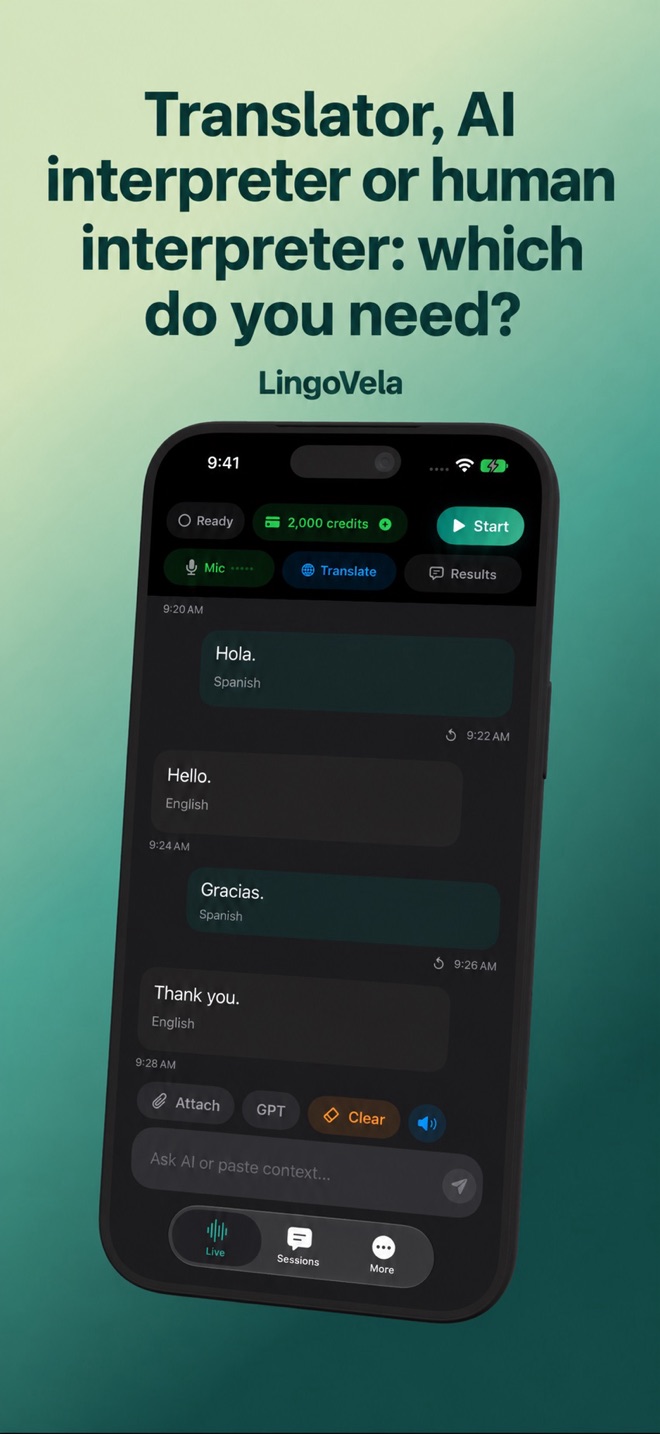
LingoVela provides its own conversation screen with original and translated text on iPhone and iPad. It is not a certified interpreter service, sign-language recognition system or emergency communication service. It does not book a professional or promise an automatic handoff to one.
All translation modes require an active subscription. On Device needs compatible prepared resources and uses no AI credits. OpenAI · Online and Private Cloud Compute require internet, credits and the relevant provider consent. Check provider handling and saved data separately; choosing a local translation mode does not erase the account, purchase and usage records described in the privacy policy.
Choose an app for a checked exchange that matches its actual capabilities. If you need a human professional, arrange that service separately. Read the support requirements before relying on a mode, device or language.
Is an AI interpreter app the same as a qualified interpreter?
No. Producing translated speech or text does not establish professional qualifications or acceptance for your appointment. Confirm the task and required service with the organisation involved. LingoVela does not provide a certified interpreter.
Can the same professional translate a document and interpret a meeting?
Ask about both assignments, language directions and relevant competence separately. Do not assume one credential or a successful conversation covers written work too. Confirm who will deliver and review each result.
Does simultaneous mean there is no delay?
Do not treat the label as a zero-delay guarantee. Check the actual turn-taking and recipient output with the chosen service and equipment. A connection method and an interpreting mode describe different aspects of the setup.
What should I do when the app’s translation is unclear?
Check the original recognised words, ask for a simpler or written clarification and stop relying on the uncertain result. Use the agreed fallback or arrange appropriate human assistance. Keep the disputed detail visible for the handoff.
Is an app always the cheaper choice for a business task?
Compare the accepted result and full cost, including usage limits, preparation and a usable fallback. An inexpensive option that does not complete the required task is not an equivalent quote. No fixed savings or return on investment is promised.