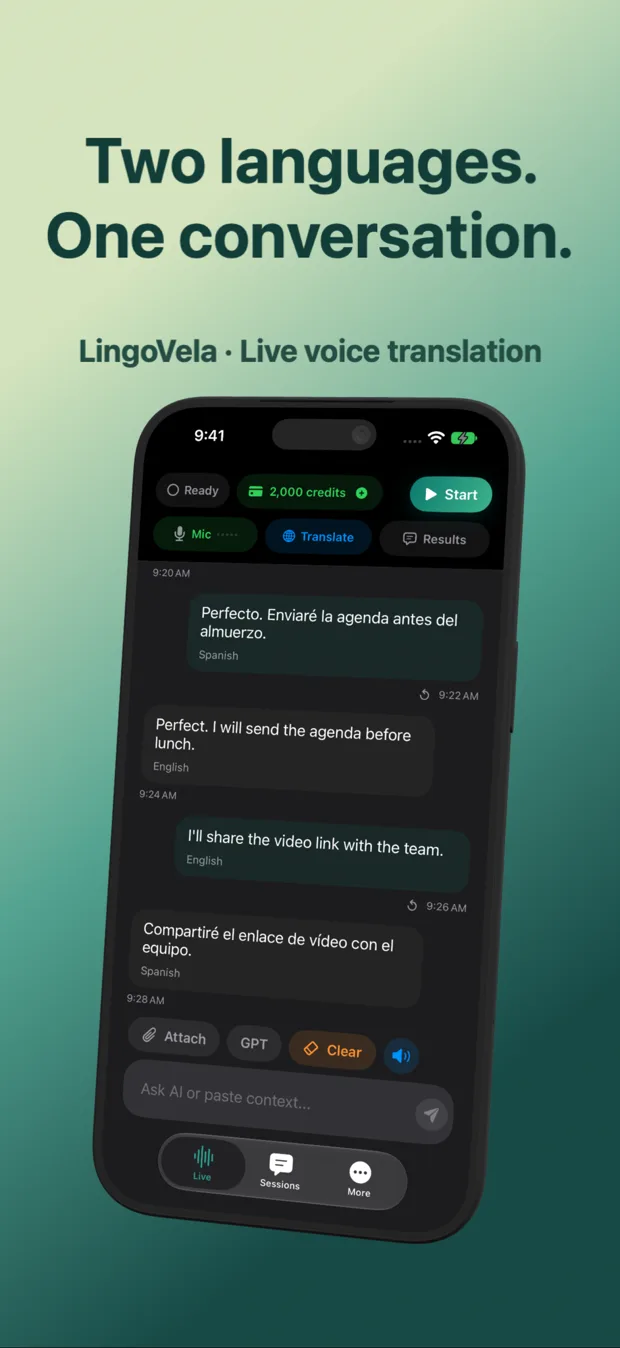
Simultaneous streaming vs turn-based consecutive AI voice translation compared
Marketing demos love “zero-delay simultaneous AI interpretation” that speaks while the other person is still talking. In real two-person conversations on a phone, however, simultaneous audio often talks over the speaker, feeds back into the microphone and guesses wrong before a verb or negation arrives at the end of the sentence—making clean turn-based consecutive translation far clearer across a table.
1. Why grammar structure punishes premature simultaneous guessing
In German, Japanese, Korean and Turkish, the main verb—and often whether the entire action happened or DID NOT happen—arrives at the very end of the sentence. An engine forced to speak English after the first four words has to guess or awkwardly revise mid-stream.
Turn-based consecutive translation waits for a complete thought (1–2 sentences), settles the recognized source text and delivers one coherent spoken and written reply.
| Factor | Consecutive / Turn-Based (LingoVela table workflow) | Simultaneous Streaming (Lecture / Split-Bud Mode) |
|---|---|---|
| Handles verb-final languages (Japanese, Korean, German) | High accuracy — sees full clause & negation before speaking | Prone to mid-sentence reversals or awkward corrections |
| Works on shared phone speaker without headphones | Yes — Speaker A finishes, then phone speaks cleanly | Poor — phone speaks over Speaker A and hears its own echo! |
| Hardware required | Just your iPhone or iPad | Requires headphones/earbuds to isolate simultaneous audio |
| Best for 20-minute one-way lecture or keynote | Tiring if speaker never pauses | Better fit — continuous listening through headphones |
| Verification of numbers & conditions | Easy — settled text turns stay readable on screen | Harder — partial hypotheses flicker and rewrite live |
2. Partial recognition text vs settled translation
Many speech pipelines display changing intermediate words while someone is still talking, then lock in the final wording after a pause. Never act on a price, dose or street number until the speaker finishes the sentence and the text settles.
| Speaking habit | Result in live AI translation | Better habit |
|---|---|---|
| 90-second uninterrupted monologue with 6 topics | Listener forgets point #1; higher chance of session pause | Pause naturally every 1–2 complete sentences (~8–15 seconds) |
| Single isolated word (“Tomorrow?” / “Bank?”) | Too little context to disambiguate homophones | Use a short complete sentence (“Can we visit the bank tomorrow?”) |
| Two people talking over each other | Merged transcript attributes words to wrong speaker | Agree simple turn-taking before starting |
3. Picking the right rhythm for your task
Choose simultaneous headphone listening for one-way speeches where you cannot ask the lecturer to pause; choose turn-based LingoVela sessions whenever two people are actually conversing.
| Scenario | Best approach | Why |
|---|---|---|
| Two-person conversation at a table, clinic reception or shop | Turn-based exchange in LingoVela | Clear turns, zero speaker overlap and settled visual text |
| Listening silently to a 45-minute foreign conference talk | One-way listening mode + headphones | Speaker will not pause every two sentences for you |
| Bilingual family dinner | Short 1–2 sentence turns on iPhone/iPad | Keeps everyone engaged without drowning out voices |
Why do words on screen sometimes change right as I finish speaking?
Speech recognizers refine early phonetic guesses once they hear the rest of your sentence—always read the settled final line.
Can LingoVela separate three people speaking at the exact same moment?
No single-microphone phone app reliably untangles overlapping voices; pause and let each speaker repeat their point cleanly.
Does LingoVela let me start and stop sessions when I choose?
Yes—you control start and stop explicitly, and unused reserved AI credits return to your balance when a session ends.