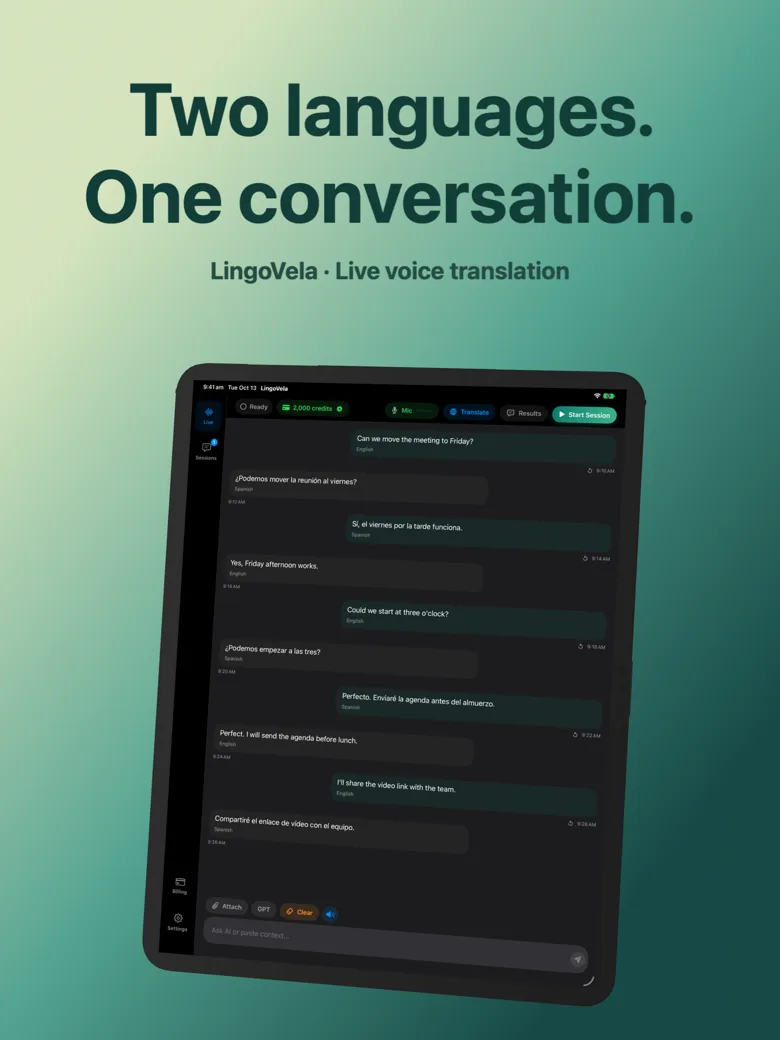
Consumer AI voice translators (LingoVela) vs certified medical & legal human interpreters
No consumer AI voice translator—including LingoVela, Apple Translate, Google Translate or DeepL Voice—is a substitute for a qualified human medical, legal or sign-language interpreter when health, legal rights or binding obligations are on the line. Knowing the exact boundary lets you use LingoVela confidently for everyday travel, family and routine logistics while arranging professional interpretation whenever consequences matter.
1. Accountability, clarification and error detection compared
A trained human interpreter actively monitors comprehension, asks for clarification when a speaker mumbles a medication dosage or double negative, observes professional confidentiality codes and carries institutional accountability. Machine speech translation processes audio statistically and can mishear a negation (“do not take” vs “take”) with fluent confidence.
Arte Soft states explicitly in LingoVela’s documentation: translations can be inaccurate or delayed—always verify names, numbers and anything with medical, financial or legal consequences.
| Dimension | LingoVela: Live Translate | Certified Human Interpreter (In-Person / OPI / VRI) |
|---|---|---|
| Availability | Instant on iPhone / iPad, 24/7 including On-Device offline | Scheduled ahead or 30–120s connect via OPI/VRI phone/video |
| Handles clinical/legal liability & informed consent | No — never use as sole tool for high-stakes consent | Yes — trained in medical/legal terminology & ethics |
| Active clarification of ambiguous speech | No — translates recognized text without questioning speaker intent | Yes — intervenes professionally to resolve ambiguity |
| Sign language (ASL / BSL / etc.) | Not supported (spoken/text languages only) | Available via qualified VRI / in-person Deaf interpreters |
| Cost | $9.99/mo consumer app subscription | $1.50–$4.00/min (phone/video) or hourly on-site minimum |
2. Privacy & regulatory frameworks (HIPAA, court rules, workplace policies)
Hospitals, courts and regulated agencies operate under statutory language-access rules and Business Associate Agreements that consumer App Store downloads do not provide.
| Setting | Consumer AI app permissible? | Required standard |
|---|---|---|
| Hospital informed consent, diagnosis or discharge instructions | No — patients have language-access rights to qualified interpreters | Qualified medical interpreter (in-person, VRI or OPI) |
| Police interview, immigration hearing, notarization or court | No | Sworn / court-certified interpreter |
| Asking pharmacy counter for bandages or finding hospital parking | Practical for low-risk logistics (verify labels visually!) | Confirm product packaging & dosage with pharmacist |
| Everyday travel, dining, directions & family conversation | Yes — ideal consumer workflow | Consumer voice translator + visual number check |
3. Safe verification habits when using LingoVela for everyday tasks
Even in low-risk daily errands—like booking a train ticket or explaining an ingredient preference—combine spoken translation with visual verification on LingoVela’s dual-language screen.
| Detail type | Risk in voice-only translation | How to verify safely |
|---|---|---|
| Prices, dates, platform numbers & times | Homophones (“15” vs “50”) misheard in noise | Point to the digits on LingoVela’s transcript or type them |
| Negations (“no peanuts”, “not Tuesday”) | Dropped “not” reverses entire meaning | Show translated text in native script & confirm with a short yes/no |
| Proper nouns, street names & hotel addresses | Phonetic transcription mangles spelling | Show the original map/booking address on screen |
Can a clinic receptionist use a personal iPhone translator instead of hospital interpreter services?
Healthcare staff must follow their institution’s approved language-access policy and regulatory rules rather than using unapproved consumer apps for clinical communication.
Does LingoVela support American Sign Language (ASL)?
No. LingoVela translates spoken audio and written text, not visual sign languages.
Why does LingoVela show both original and translated text on screen?
Showing the recognized source sentence lets you spot immediately if background noise caused the microphone to mishear your own words before trusting the translation.