Russian–English & Ukrainian–English Live Voice Translator on iPhone
Real Russian & Ukrainian–English voice translation conversations rarely fail on basic nouns—they fail on case endings that change meaning even when word order shifts and false friends and mixed russian/ukrainian (surzhyk) speech in family or community conversations. Preparing your iPhone or iPad with the right translation mode, visual transcript habits, and offline backup turns stressful exchanges into calm, verifiable dialogues.
The two biggest pitfalls in Russian & Ukrainian–English voice translation
First, watch out for case endings that change meaning even when word order shifts. Generic phrasebooks gloss over this, leaving you confused as soon as the other person responds at natural speed.
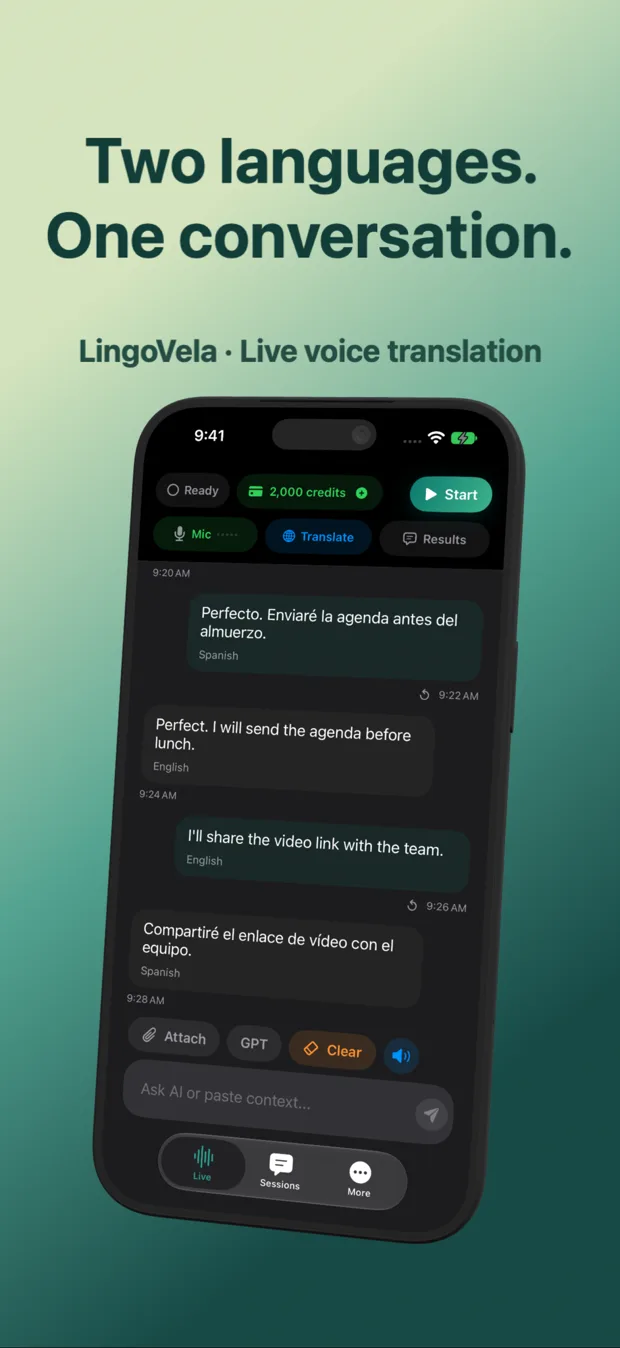
Second, pay close attention to false friends and mixed Russian/Ukrainian (Surzhyk) speech in family or community conversations. Because LingoVela displays the recognized source words alongside the settled translation, both speakers can verify critical details before acting on them.
Step-by-step iPhone & iPad workflow that prevents misunderstandings
Keep sentences concise—one clear idea per turn—and always confirm names, times, and amounts visually on screen.
- Select both spoken languages and confirm whether you are using On-Device (offline, 0 credits), Apple Private Cloud Compute, or OpenAI · Online.
- Run a quick pre-check phrase such as: 'Which documents do we need to bring to the municipal registration office on Tuesday morning?'
- Wait half a beat after the speaker finishes so final punctuation and clause-end negations settle cleanly.
- Point to numbers, dates, or addresses on the dual-language transcript so the other person gives an explicit nod.
Offline readiness & free zero-upload preparation tool
Before heading into buildings with thick stone walls, subways, or roaming dead zones, test your downloaded language pair in Airplane Mode—and bookmark our free browser Multilingual Medical & Allergy Card Generator (/tools/emergency-allergy-and-medical-translation-card/) for zero-upload practice or quick visual cards.
Can both speakers verify Cyrillic spelling of names and street addresses on screen?
Yes—dual-language transcripts show full Cyrillic alongside English so transliteration spelling errors are caught immediately.
Should I use On-Device or OpenAI mode for this scenario?
Use On-Device when offline, conserving AI credits, or keeping speech strictly local on supported pairs; switch to OpenAI · Online or Private Cloud Compute when you have solid signal and want wider idiomatic coverage.